
 FREE SHIPPING on US orders over $150. Need help? Contact Us
 Genuine Agate Gemstone
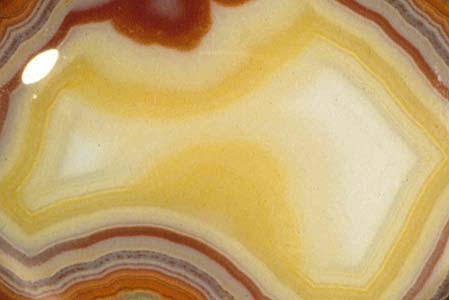 Agate (Pronunciation: \'a-gt\): Stripe up the Bands
No gemstone is more creatively striped by nature than agate, chalecedony quartz that forms in concentric layers in a wide variety of colors and textures. Each individual agate forms by filling a cavity in host rock. As a result, agate often is found as a round nodule, with concentric bands like the rings of a tree trunk. The bands sometimes look like eyes, sometimes fanciful scallops, or even a landscape with dendrite trees.
Agate was highly valued as a talisman or amulet in ancient times. It was said to quench thirst and protect from fevers. Persian magicians used agate to divert storms. A famous collection of two to four thousand agate bowls which was accumulated by Mithradates, king of Pontus, shows the enthusiasm with which agate was regarded. Agate bowls were also popular in the Byzantine Empire. Collecting agate bowls became common among European royalty during the Renaissance and many museums in Europe, including the Louvre, have spectacular examples.
 The mining of agate in the Nahe River valley in Germany which was already documented in 1497 gave rise to the cutting center of Idar-Oberstein, Germany. Originally, the river was used to power the grinding wheels. When the Nahe agate deposit was exhausted in the nineteenth century, Idar cutters started to develop the agate deposits of Brazil, which also sparked exploration and discovery of Brazil's rich deposits of amethyst, citrine, tourmaline, topaz, and other gemstones.
Although the small town of Idar-Oberstein is still known for the finest agate carving in the world, today Idar imports a huge range of other gem materials from around the world for cutting and carving in Germany and Asia. Cameo master carvers and modern lapidary artists flourish along with rough dealers who scour the world for the latest gem discoveries for export. And the entire industry sprung from the taste for agate bowls and ornaments during the Renaissance! Maybe agate is also a powerful talisman for success in international trade!


